Analogous Organs Plants Chart Manufacturer,Supplier and Exporter in India
Product Code : EL-GAEC-10117
Lab Instruments Manufacturers manufactures the Analogous Organs Plants Chart in-house at our own India facility, supplying it to schools and colleges teaching evolutionary biology, and as an OEM/private-label item to distributors and exporters across India and internationally.
What This Chart Covers
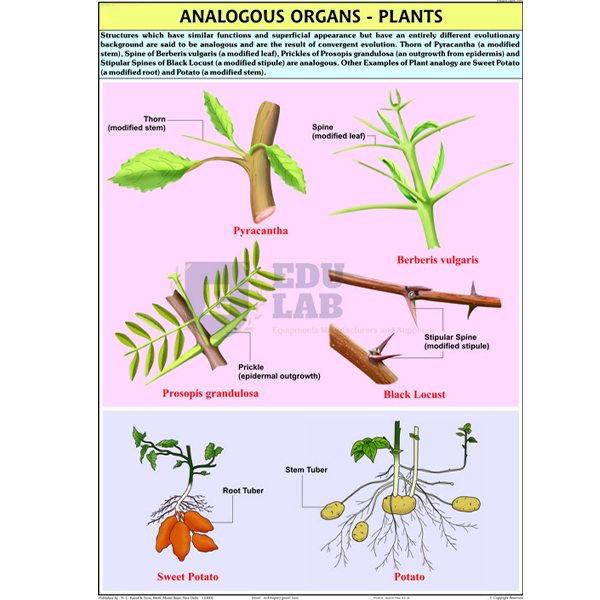
This chart illustrates plant analogy through four defensive-structure examples: the thorn of Pyracantha, the spine of Berberis vulgaris, the prickles of Prosopis grandulosa, and the stipular spines of Black Locust. All four structures serve the same defensive function, but unlike the homologous examples in our companion chart, they develop from different plant organs in each case — making them analogous (same function, different origin) rather than homologous (same origin, different function). It measures 70 x 100cm, printed on synthetic paper for durability under repeated classroom handling, with all labelling in English.
Chart details
| Size | 70 x 100cm |
| Material | Synthetic paper |
| Labelling | English |
Typical Classroom Use
Schools and colleges use this chart in evolutionary biology and botany coursework to teach analogous structures and convergent evolution, and it is best taught directly alongside our Homologous Organs Plants Chart and Homologous Organs Animals Chart, so students can directly contrast analogy against homology using matched plant examples.
Manufactured In-House
This chart is printed at our own India production facility on synthetic paper stock. Manufacturing in-house means our team controls print quality and durability at every stage, and can produce custom sizes or bulk classroom sets for a specific school order or export shipment without waiting on an outside supplier.
Frequently Asked Questions
What is the difference between analogous and homologous organs?
Analogous organs share the same function but develop from different origins (this chart's examples); homologous organs share the same origin but may serve different functions (see our companion homology charts).
What examples does this chart show?
The thorn of Pyracantha, the spine of Berberis vulgaris, the prickles of Prosopis grandulosa, and the stipular spines of Black Locust — four different defensive structures with a shared protective function.
Can this be supplied as an OEM/private-label order?
Yes, it can be produced and packed under a buyer's own brand name and item codes for distributors and exporters ordering in bulk.
Related Charts
The contrast works best with Homologous Organs (Plants) Chart and Homologous Organs (Animals) Chart on the same wall, and Hybridisation Chart and Pedigree Analysis Chart cover the inheritance half of the syllabus. Find all five in Genetics and Evolution Charts, part of Charts, or request a quote through Contact Us.
Last updated: October 2026.